
Palatka Railroad Preservation Society


  • Home
  • History
  • Trackside
  • RailRodeo
  • Calendar
  • Photos/Videos
    • Photos >
      • Palatka layout
      • recent local photos
      • GS&F slide show
      • Cabooses
      • old pictures of Palatka
      • old local railroad photos
    • Videos
  • About Us
    • Find Us
    • Join Us!
    • Contact Us
  • Links

3rd  Quarter 2025

7/15/2025

 
Picture
Mainline Report
 Our new slate of Officers and Board Members are:
     President – Aubrey Walker
     Vice President – Jerry Iser
     Secretary – Jody Counts
     Treasurer – Howard Blasczyk
     Board Member – George Gibson
     Board Member – Jonathan Filion
     Board Member – Mark Frazier
 
We also have had some new members join our group this year. We welcome them ‘all aboard’!
 
Please invite anyone you know that might be interested in any of the aspects of Palatka Railroad Preservation Society to our Open House to or any of our members’ activities. We need members and volunteers  to be available on select days/times to operate layouts and greet guests, even if you can only spare a few hours.


UPCOMING EVENTS
Calendar Dates

Saturday – July 12th - 9 AM to 3 PM                  
Golden Spike TRAIN SHOW
Volusia County Fairgrounds    
3150 E. New York Ave., Deland           

 
Saturday – July 26th – 10 AM to 3 PM
Ocala Model RRs Historic Pres. Society
Bi-monthly Open House
1247 N.E. 3rd St., Ocala
 
Tuesday – August 5th – 5 PM til
Members Work Day

Saturday – August 9th – 9 to 10 AM
Members O.H. Preparation
 
3rd Quarter OPEN HOUSE
David Browning Railroad Museum
HO scale model railroads operating
222 N. 11th St., Palatka
Saturday, August 9th
10 AM – 2 PM


Did You Know?
 
Numerous logging railroads existed in northeast Florida, beginning in the 1870s  and continuing into the 1920s. Some  existed to supply to supply their own mills. Some were constructed to move the timber to bodies of water for transport to distant mills.
 
They varied in length from 1-mile to 30 miles. Often rails were laid with minimal or no ballast, some were temporary and would be relocated once an area was harvested. Many companies even owned multiple locomotives.
 
Some of the companies were:
Wilson Cypress
E.P. Rentz Lumber
Rodman Lumber
Tilghman & Sons
Welaka, Norwalk & Lake
Clifford & Keay Lumber
J.W. Jones Lumber
Dupont Railway & Land
V.J. White
McDowell Crate
Ford-Rembert Lumber
Carter & Williams
East florida Land & Produce
Western Railroad of Florida
R. B. Cotter
Dowling Shands Lumber
Leno Logging
Scotland Mills

 
 New Museum Acquisitions

This section usually acknowledges our most recent acquisitions. As part of our stated purpose to preserve the heritage of the rail history of Palatka and surroundings, we are seeking photographs (or copies) of:
   Trains ‘street-running’ on Main & Laurel
   Rail yard & maintenance facilities in Palatka
   Old train depots throughout Putnam
   Other historical rail photos from the 1900s


HISTORY
 
 Palatka Bridge Company
  
In 1886 with railroad lines located on both sides of the St. Johns River, passengers and freight cargo had to be ferried via steamship or boat to make connections between the rail lines on opposite banks. 
 
According to news accounts, rail bridges were discussed and proposed by railroad officials. In 1887, the Palatka Board of Trade called a meeting to gauge public opinion on the matter. Citizens desired a combination rail, pedestrian, and wagon bridge.
 
Location of where the bridge would cross was debated, as well as the type of bridge. It was said a draw span would not be required, if constructed from the 25-foot bluff at Rolleston. It also seemed that direct access from some rail lines would put the others at a competitive disadvantage.
 
After much speculation and rumors, the bridge’s location was finalized. Right-of-way deeds were for a railroad bridge over the St. Johns River in January of 1888. On the east bank it was north of Hart’s Point, and the west bank it was at Main St. (north of busiest section of riverfront). The river narrows to about one-mile wide where the bridge would cross.
 
Stock was issued by Utley J. White’s St. Johns River and Halifax Railroad for the construction and operation of a rail bridge with a draw span (no wagon or pedestrian passageways).  
 
The bridge company was organized on August 15, 1888. A contract with T. H. Brown and Co. was signed on October 1, 1888. The construction contract was an ambitious one, with the bridge to be completed by the 10th of December, in just seventy days. It was completed on schedule.
 
Palatka Bridge Co. originally connected the Florida Southern Rwy. in Palatka with St. Augustine & Palatka Rwy. and St. Johns & Halifax River Rwy. on the east side of the river.


1st Quarter Spring 2025

1/29/2025

 
Picture
Mainline Report
 
The David Browning Railroad Museum, located adjacent to the waiting room in the train station, is open based on Ride Solutions staffing (typically Mon.–Fri., 9AM–5PM).
 
Quarterly Open House Events with both HO scale model railroads operating have resumed for 2025. They are scheduled for Saturdays in February, May, August, and November. Visit our website for updates.
 
We are seeking model railroaders who are either new to the area or unaware of our existence to partner with us.
 
If you have any interest in railroads, scale model railroads, or local railroad history, we encourage you to contact us and connect with like-minded people.
Contact us via voice mail at (386) 328-0305, or at [email protected]


UPCOMING EVENTS
Calendar Dates

Saturday – Feb. 1st / 9AM-4PM
Sunday –Feb. 2nd / 10AM-3PM
The Villages Model Train Show & Sale
Savannah Recreation Center
1545 N. Buena Vista Blvd. The Villages, Florida
 
Saturday – February 10th 9 AM to 4 PM
Golden Spike TRAIN SHOW                                
Prime Osborn Convention Ctr.   
1000 Water St., Jacksonville               
 
1st Quarter
P.R.P.S. OPEN HOUSE EVENT
David Browning Railroad Museum
HO scale model railroads operating
Saturday, February 15th
10 AM – 2 PM
 

Did You Know?
Numerous businesses and industries were served by rail in Palatka when tracks ran down the center of Laurel, Main, and Dunham Streets. Although the tracks initially ran to the wharves on the riverfront to facilitate water to rail transfer (or vice versa) of passengers and cargo, numerous customers were added on the line, some were even served by sidings or spur tracks.
 
Some of the earliest were:
Vertrees & Co. – Grain wholesalers
Tilghman & Sons – Planning mill
G.M. Davis & Sons – Cypress tanks
Stringfellow & Padgett – Grocery
Squires Lumber –
Merryday Grocery - Wholesalers
Porter Bros. – Saw & planning mill
Gulf Refining – Petroleum distributor
Seldon Cypress Door & Shingle Co.
Wilson Cypress Co.
Florida Wooden Ware
Putnam Handle Mfg.
J.A. Champion – Building Materials
Gem City Milling Co.
Peninsular State Oil Co.
T.J. Barnett Boiler & Machine Works
Standard Oil Co.
Stanton Foundry & Machine Works
Southern Veneer Co.
H.W. Taylor Concrete
Municipal Water Works
County Fairgrounds (on Kirby St.)


HISTORY
auto-train
 
auto-train was a private corporation, formed in 1970, by Eugene K. Garfield. It was chartered to provide a uniquely different passenger rail travel experience by allowing you to take your car with you. As many passenger railroads were curtailing or discontinuing passenger service, the corporation purchased surplus equipment for its train service. New diesel locomotives were purchased from GE. Enclosed auto racks were purchased from Canadian National. All equipment was painted in a distinctive white, red, and purple scheme.
 
The route roughly paralleled I-95 between Sanford, Florida and Lorton Virginia (south of Washington, DC). It utilized leased tracks of the Atlantic Coast Line (later Seaboard Coast Line) and Richmond, Fredericksburg & Potomac railroads. Initial service began in December of 1971. auto-train consists passed through Palatka daily. With no stops en route, except for refueling and an engine crew changes, the trip only took 15 1/2 hours.
 
The service was first class with passengers traveling in luxurious coach-lounge cars and sleepers. Complimentary meals were provided in dining cars, entertainment provided in the nightclub car, while the automobiles were transported in fully enclosed car carriers.
 
Due to initial success of the service, it was decided to add another route. The added route would operate between Sanford and Louisville, Kentucky. Service began in 1974, but was discontinued in 1977. The second route was discontinued due to: the cost of adding the route, which was not as strong of a market, and inadequate revenue to cover operating costs. That did not save auto-train from filing bankruptcy. It continued to provide its unique service on the initial route until April of 1981.
 
Amtrak revived the concept in late 1983. It initially used surplus Amtrak passenger equipment and 2nd hand auto-train auto racks. Superliner passenger equipment was added in the 1990s. Their auto racks currently carry cars. vans, pickup trucks, motorcycles, and even small campers and boats.  After operating its Auto Train for more than forty years, it is one of Amtrak’s highest revenue routes.


New MUSEUM ACQUISITIONS
This section usually acknowledges our most recent acquisitions. As part of our stated purpose to preserve the heritage of the rail history of Palatka and surroundings, we are seeking photographs (or copies) of:                         
  • Trains ‘street-running’ on Main and Laurel
  • Rail yard & maintenance facilities in Palatka
  • Old train depots throughout Putnam County
  • Other historical rail photos from the 1900s


Spring 2024

5/7/2024

 
Picture
Mainline Report
The museum is open based on Ride Solutions staffing (typically Mon.–Fri., 9AM–5PM). Open House Events are scheduled quarterly. Revisit our website, where we will announce other activities as they are resumed.

Our activities require members and volunteers to be available on select days/times to operate the layouts and greet guests. If you have any interest in railroads, history, or model railroading, we invite you to partner with like-minded people. Even if you can only spare a few hours each month, we still encourage your involvement.

Contact us via email:
[email protected]
Leave a voice mail message (include name & number) at: (386) 328-0305


UPCOMING EVENTS
Calendar Dates
Saturday – May 18 th                                       Saturday – May 25 th – 9 to 10 AM
Regal Railways TRAIN SHOW
Hernando County Fairgrounds
6436 Broad St., Brooksville, Fl.
9 AM to 2 PM

Saturday – May 25 th – 9 to 10 AM
Members O.H. Preparation
Saturday – May 25 th – 10AM to 2PM
OPEN HOUSE EVENT
Browning Railroad Museum
HO scale model railroads operating

Saturday – June 8 th
LIONS CLUB TRAIN SHOW
1908 E. Ft. King St., Ocala, Fl.
9 AM to 2 PM

Saturday – July 3 rd
Golden Spike TRAIN SHOW
Volusia County Fairgrounds
SR44 East, Deland, Fl.
9 AM to 4 PM


Did You Know?
During the steam locomotive era there were numerous locomotive manufacturers in the
United States. Some railroad companies even produced locomotives in their own shops in
the 1900s.

BLW (Baldwin Locomotive Works), Brooks Locomotive Works, Cooke Locomotive &
Machine Works, Lima Locomotive Corp., Richmond Locomotive Works, Rhode Island
Locomotive Works, and Schenectady Locomotive Works were several that dated
from the 1800s.

Matthias Baldwin, BLW’s founder, produced its first steam locomotive in 1832. Called “Old
Ironsides”, it remained in active service for twenty years. BLW manufactured Southern
Pacific’s distinctive “Cab Forward” locomotives.

ALCO (American Locomotive Company was formed in 1901 It was formed by the merger
of seven locomotive manufacturers (some of those listed above).

Norfolk & Western, Illinois Central, and Reading were among a few of the railroad companies that built steam locomotives in their own machine shops in the 1940's.

HISTORY
Florida Railroads during the Civil War

The War Between the States became the world's first railroad war. Florida had limited rail mileage, 425 miles, at the beginning of hostilities. Its isolated rail lines were primarily used to move troops and supplies to ports and river landings. Being an asset the Confederacy could not afford to lose, they became targets for Union forces. The Federal Navy's first target was Cedar Key followed by Fernandina, the endpoints of Florida's longest line, the Florida Railroad. Any equipment considered useful to the “Feds” was confiscated.
Both terminals had equipment, warehouses, and trestles destroyed. Some portions of the line in the state's interior remained intact, and was of some use to the Confederacy.
When Confederate forces abandoned Pensacola, they took equipment from the Florida & Alabama R.R., and salvaged the rails rather than have them fall into enemy hands. The second longest line, located between Tallahassee and Lake City, having no ports, remained intact.
During 1864, a rail line became directly involved in hostilities. The right-of-way between Jacksonville and Lake City was utilized by Union Troops marching west to destroy a bridge over the Suwannee River. At what became known as the “Battle of Olustee”, Union forces were soundly defeated by a smaller force of Confederates. A Confederate gun detachment with a 30-pound Parrot gun mounted on a flatcar saw limited use during this battle.
At the conclusion of hostilities Florida's railroads were in shambles. After martial law was declared, the Federal military took control of Florida's railroads. The military did provide limited repairs and restored some of the larger lines to operation. During the Reconstruction Era, some of the lines succumbed to the fraud of carpetbaggers.
By 1881, Florida's Internal Improvement Fund was issuing land grants for railroads.


New MUSEUM ACQUISITIONS
We need photos (or copies) showing Palatka and surrounding areas‟ rail history.
We are interested in: trains "street-running‟ on Main & Laurel; rail yard & maintenance
facilities in Palatka; train depots throughout Putnam County; businesses served by rail; as well as any other historical rail photos from this area.


Winter 2024

1/1/2024

 
Picture
Mainline Report
The museum is open based on Ride Solutions staffing (typically Mon.–Fri., 9AM–5PM). Open House Events are scheduled quarterly. Revisit our website, where we will announce other activities as they are resumed.
Our activities require members and volunteers to be available on select days/times to operate the layouts and greet guests. If you have any interest in railroads, history, or model railroading, we invite you to partner with like-minded people. Even if you can only spare a few hours each month, we still encourage your involvement.

Contact us via email:
[email protected]
Leave a voice mail message (include name & number) at: (386) 328-0305

UPCOMING EVENTS
Calendar Dates
Saturday – February 10th – 9 AM to 4 PM
Golden Spike TRAIN SHOW
Prime Osborn Convention Ctr.
1000 Water St., Jacksonville

Saturday – February 17th – 9 to 10 AM
Members O.H. Preparation

Saturday – February 17th – 10AM to 2PM
OPEN HOUSE EVENT
Browning Railroad Museum
HO scale model railroads operating

Saturday – March 9th – 9 AM to 2 PM
LIONS CLUB TRAIN SHOW
1908 E. Ft. King St., Ocala

Saturday – April 6th – 9 AM to 4 PM
Golden Spike TRAIN SHOW
Volusia County Fairgrounds
SR44 East, Deland

Did You Know?
Many early rail lines organized for construction in Florida would only exist on
paper. Palatka had its share of “paper railroads” as well.
Palatka's first was the Palatka Orange Spring Railway organized in 1870 by local steamboat and stage line operator, Hubbard L. Hart.
Also in 1870, was the Great Southern Railway, which was to pass through Palatka
on its way south. Within five years this project was “canned”.
Palatka & Sanford Railroad incorporated in 1881. With no construction in progress, their
reserved Land Grant acreage was given to another railroad in 1883.
The Jacksonville & Palatka Railway published a Notice of Incorporation in 1882. The line
was planned to be sixty-five miles. 1885 produced four more “paper railroads” for
the Palatka area: Palatka & Ocklawaha River Railway; St. Augustine & Seaboard Rwy. (with a branch to Palatka); Drayton Island & Gulf Railroad; and Homosassa, Ocala & Palatka Railroad.
In 1887, five more lines were planned, but never constructed.

We need photos (or copies) of the rail history of Palatka and surrounding areas.
We are interested in: trains "street-running‟ on Main & Laurel; rail yard & maintenance
facilities in Palatka; train depots throughout Putnam County; businesses served by rail; as
well as any other historical rail photos from this area.

HISTORY
FEC (Florida East Coast Railroad) Predecessor:
Palatka Bridge Company
In the mid-1880s, Palatka was served by rail lines on both sides of the river. Any passenger connections or freight interchange between the rail lines on opposite banks of the river had to be accomplished via ferry boats. Thus the need for a rail bridge across the St. Johns River at Palatka was obvious.
Around 1886, rumors began circulating regarding a railway bridge at Palatka. With four rail lines have four different riverfront wharfs locations, speculation abounded as to what rail company would build it, as well as where it would cross the river.
In June of 1887, officials from Florida Southern, St. Augustine & Palatka, and St. Johns & Halifax met to discuss a rail bridge at Palatka. Local business men envisioned a bridge to accommodate trains, vehicles (wagons), and pedestrians.
Pros and cons of the proposals were aired in the local newspapers. Each proponent stated why their proposal made the most sense. The controversy over who, and where, continued into 1888.
After a few years of speculation, discussion and rumors, the bridge‟s location was finalized. It obviously was not determined by the newspaper editors or even public sentiment. Right-of-way deeds for a railroad bridge over the St. Johns River at Palatka were recorded in January of 1888.
Apparently, common sense prevailed. Constructing multiple railroad bridges or making the western connection at the busiest section of the riverfront might be a hindrance to river traffic. The location finally selected was apparently the most logical.
The Palatka Bridge Co. was organized in August of 1888 for the expressed purpose of constructing and operating a railway bridge across the river at Palatka. Construction bonds were issued By St. Johns & Halifax Rwy. The river narrows to about one-mile wide where this bridge crossed. After a seventy day construction period, the bridge was
completed on December 10th.

Fall 2023

11/1/2023

 
Picture
Mainline Report
The museum is open based on Ride Solutions staffing (typically Mon.–Fri., 9AM–5PM). Open House Events are tentatively scheduled quarterly. Revisit our website, where we will announce activities as they are resumed.
Our activities require members and volunteers to be available on select days/times to operate the layouts and greet guests. If you have any interest in railroads, history, or model railroading, we invite you to partner with like-minded people. Even if you can only spare a few hours each month, we still encourage your involvement.

Contact us via email:
[email protected]
Leave a voice mail message at:
(386) 328-0305


UPCOMING EVENTS
Calendar Dates

Saturday – November 4th
LIONS CLUB TRAIN SHOW
1908 E. Ft. King St., Ocala
9 AM to 2 PM

Members O.H. Preparation
Saturday – November 11th – 9 to 10 AM


OPEN HOUSE EVENT
Saturday – November 11th – 10AM to 2PM
Browning Railroad Museum
HO scale model railroads operating


Did You Know?
During World War I most railroads in America, along other carriers and communications, were under government control.
The railroad companies had created a “War Board” in an attempt to support the war effort, but ran into numerous problems. As a voluntary organization, it had no authority to enforce any decisions made. On December 26, 1917, Woodrow Wilson established the United States Railroad Administration by Presidential Proclamation. Its stated purpose was the operation of railroads, communication companies, and interstate trucking. This included the control of 385 major railroads.
Duplicate and competing services were eliminated or reduced. Standard locomotive designs were developed and numerous locomotives were produced. Railroads received financial compensation base on 3 years of previous operations.
About a year after the Armistice was signed, the railroads were returned to private control. By this time many rail lines were simply worn out. Within 3 years the railroads received their final compensation from the government and began the rebuilding process.

We are still seeking photos (or copies) as part of our purpose to preserve the heritage of the rail history of Palatka and surrounding areas. We are interested in: trains "street-running‟ on Main & Laurel; rail yard & maintenance facilities in Palatka: train depots throughout Putnam County; as well as any other historical rail photos from this area.
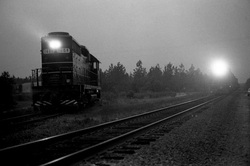

HISTORY
Atlantic Coast Line predecessor:
The Plant System


Henry Bradley Plant (1819-1899), a Connecticut native, first business dealings in the South began in the express business. During "War Between the States‟, he purchased the southern division of Adams Express Co. and in 1861 created “Southern Express Co.". After the war, the handling of packages and parcels via stagecoach and ships would soon transition to the railroads. After the War Between the States, Henry Plant began purchasing bankrupt railroad companies serving the south. When feasible, the lines would be connected with one another, thus he was instrumental in the consolidation of many of North Florida's lines. Plant acquired stock ownership in several Florida rail lines. He also invested a portion of his profits in steamship lines, developing ports and other infrastructure, and the building of hotels in Florida. In 1882 he formed a company for his acquisitions, the Plant Investment Co. (PICO) with headquarters in Sanford. By 1893 his Savannah, Florida & Western Rwy., Charleston & Savannah Rwy., South Florida R.R., and Brunswick & Western R.R. lines totaled 1083 miles in several southeastern states. His “system” also included steamship lines. Next Plant acquired the Jacksonville, Tampa & Key West Rwy. When Henry Plant died in 1899, his rail empire included over 2,200 miles of track. Plant's holdings were not a single corporation although many of the railroad companies operated together, thus the “Plant System” name. After a 21/2 year legal battle, his widow agreed to sale the railroad to the Atlantic Coast Line Railroad Company, and the system ceased to exist. The Atlantic Coast Line had been formed in 1900 with the merger of 5 railroad companies in Virginia, North Carolina and South Carolina. Then in 1902 A.C.L. acquired Plant's Florida railroads.


Summer 2023

8/4/2023

 
Picture
Mainline Report

Now that the train station has re-opened for the public’s use and the parking lot construction has been completed, P.R.P.S. has begun resuming activities. The museum is open based on Ride Solutions staffing (typically Mon.–Fri., 9AM–5PM). Open House Events are tentatively scheduled quarterly. Revisit our website, where we will announce activities as they are resumed.
 
Our activities require members and volunteers to be available on select days/times to operate the layouts and greet guests. If you have any interest in railroads, history, or model railroading, we invite you to partner with like-minded people. Even if you can only spare a few hours each month, we still encourage your involvement.
 
UPCOMING EVENTS

Calendar Dates
Saturday – August 19th – 9 to 10 AM
Members O.H. Preparation

Saturday – August 19th – 10 AM to 2 PM
OPEN HOUSE EVENT
Browning Railroad Museum
HO scale model railroads operating

Saturday – Sept 30th
Ocala Model RRs Historic Pres. Soc. 1247 NE 3rd St., Ocala
OPEN HOUSE - 10 AM to 3 PM

Saturday – November 4th
LIONS CLUB TRAIN SHOW 1908 E. Ft. King St., Ocala 9 AM to 2 PM


Did You Know?
During the early days of railroading, prior to radio communications, the railroads used various means of communication. Locomotive whistles and signal lanterns were a couple of the early forms. These methods were primarily used for train crews, but could be useful to the public.

Some of the whistle signals are still in use today, although they are sounded by a diesel horn instead of a steam whistle. For instance, two short blasts mean the train is starting to move forward, while three short blasts indicate a back-up move. Prior to approaching a vehicular crossing (highway, street, or road), two long blasts, one short blast, followed by another long blast, warns vehicles and pedestrians of an approaching train.

The first railroad signal lanterns used oil or kerosene to provide illumination. Hand lanterns were used by crew members to communicate between the locomotive and the caboose, or even a crew member on the ground. Lanterns were also mounted on the front of the engine and the rear of every train. Lanterns were mounted on switch stands so crew members could determine switch alignment at night.


HISTORY
A connecting line:
Green Cove & Melrose Railroad –“Lake Sante Fe Route”
A railroad worthy of mention is Green Cove Spring & Melrose Railroad. It connected with Jacksonville, Tampa & Key West Rwy. at Green Cove Springs, as well as a junction with the Georgia Southern & Florida Railway at Newburg (1890), east of Lake Geneva, and its eventual terminus at Melrose.

Chartered in 1881, it was a proposed 33-1/2 mile narrow gauge line between Green Cove Springs and Lake Sante Fe at Melrose. Six miles of rail was laid from Green Cove by July of 1882. When it opened for revenue business in March of 1883, 10 miles of track was in place.

By the end of December of 1884, with one locomotive, a combine, and 9 flat cars, the line was in receivership. After a foreclosure sale and reorganization as Green Cove & Midland, a 10 mile lumber spur was added at Sharon. By July of 1886 it was leased by the Western Railway of Florida and an additional 5-1/2 miles of track was added reaching Belmore.

Daily (except Sunday) trains carried passengers, mail, and agricultural products; however it was mainly a logging and lumber road.

Construction resumed toward Melrose crossing the route of G. F. & S. at Newburg. By January 10, 1890 the line finally reached Melrose. Daily round trips between Green Cove and Melrose were said to have taken 2 hours with at least a dozen stops en route. By February of 1892 the line was in receivership again. After another foreclosure sale, the line emerged as the South-Western Railway. Additional equipment was added, the schedule was shortened, and Sunday trains scheduled..

By mid-1896 the line was virtually shut down, but the courts required it to continue operation. By 1899, the owners were allowed to remove rails and dispose of equipment, thus ending its existence.

New Museum Acquisitions
We are still seeking photos (or copies) as part of our purpose to preserve the heritage of the rail history of Palatka and surrounding areas.

We are interested in: trains ‘street-running’ on Main & Laurel; rail yard & maintenance facilities in Palatka: train depots throughout Putnam County; as well as any other historical rail photos from this area.

Contact us via email: [email protected]

Spring 2023

5/1/2023

 
Picture
Mainline Report
 
Now that the train station has re-opened for the public’s use and the parking lot construction has been completed, P.R.P.S. has begun resuming activities. The museum is open based on Ride Solutions staffing (typically Mon.–Fri., 9AM–5PM).  We hope to announce other activities soon.
 
Our activities require members and volunteers to be available on select days/times to operate the layouts and greet guests.  If you have any interest in railroads, history, or model railroading, we invite you to partner with like-minded people. Even if you can only spare a few hours each month, we still encourage your involvement.  
 
Check our website for future updates or contact us via email:                                          [email protected]

 
UPCOMING EVENTS
Calendar Dates
Saturday – May 13th – 9:30 to 11:00 AM
Members O.H. Preparation
 
Saturday – May 13th – 11 AM to 3 PM 
National Train Day - OPEN HOUSE

Tuesday – May 16th – 5:30 to 6:30PM
OPERATIONS NIGHT (Tentative)

Saturday – May 27th
Ocala Model RRs Historic Pres. Soc.  1247 NE 3rd St., Ocala   OPEN HOUSE - 10 AM to 3 PM
 
Saturday – June 10th
LIONS CLUB TRAIN SHOW    1908 E. Ft. King St., Ocala                         9 AM to 2 PM

 
Did You Know?
UNITED STATES RAILROAD ADMINISTRATION
 
By 1914, war had broken out in Europe. Unable to broker a peace, America finally declared war on Germany in April of 1917.
 
Before the end of the year, President Woodrow Wilson established the United States Railroad Administration in the interest of national defense. As a war measure it took control of 385 major American railroads as well as other carriers and communication companies.
 
The U.S.R.A. centralized operations and consolidated many functions. It developed “standard” designs for steam locomotives to meet the anticipated increased needs of the railroads to support the war effort. ”. Most railroad employees were exempt from military service because they were needed to operate the railroads.
 
The Railway Administration Act of 1918 “guaranteed” railroads to be returned to private control in “at least as good condition as when they were taken over
 
By March of 1920 when railroads returned to private control, many lines were simply worn out. Within three years most lines had received their final cash compensation from the government, and were able to begin rebuilding.     
 

NEW MUSEUM  ACQUISITIONS

We are still seeking photos (or copies) as part of our purpose to preserve the heritage of the rail history of Palatka and surrounding areas.
We are interested in: trains ‘street-running’ on Main & Laurel; rail yard & maintenance facilities in Palatka: train depots throughout Putnam County; any area historical rail photos.

 
HISTORY
 
An interstate line:
Georgia Southern & Florida Railway –“Suwanee River Route”
 
Originally chartered in 1881 in Georgia with a planned route from Macon, GA to Florida’s state line, it eventually crossed into Florida reaching Palatka in March of 1890. Crossing the Suwanee River near White Springs, Florida, it was promoted as the “Suwanee River Route”.
. 
Apparently the organizers ‘woke up’ when a rival company organized for essentially the same purpose. In 1886, ‘movers and shakers’ in the Gem City sought to have the terminus of the line at Palatka’s waterfront. After the two rival companies consolidated in 1887, construction finally began at Macon with maps indicating Palatka as the southern terminus of the line.
 
It was published that through trains would be operating into Palatka by fall of 1888, despite the fact that only fifteen miles of rail had been laid in Georgia. Apparently newspaper editors knew nothing about rail construction. Although the city was ‘on board’ with another railroad entering Palatka, Florida Southern and Jacksonville, Tampa & Key West initially put up “considerable opposition”.
 
The 285-mile line to Palatka officially opened March 21, 1890, when the first southbound passenger train departed from Macon, GA. One hundred eighteen miles of the interstate line was located in Florida with remainder in Georgia. The route was never extended to the west coast of Florida as originally proposed. Within a year the line went into receivership, but remained in operation. In 1895 it was sold and reorganized with a minor name change – ‘Railroad’ became ‘Railway’.  
 
In the 1900s it came under control of Southern Railway, and ultimately was consolidated with Southern Railway.

Summer 2019

6/15/2019

 
Picture
Mainline Report
Members clear your calendars for our upcoming RailFest, October 26th, Saturday. Invite former members, as well as family and friends to assist us as volunteers during RailFest. We can use them as greeters in the museum or in front of Railrodeo. Even if they are only available for an hour or two, it would be helpful. Workdays will be scheduled during September to get things ready in the museum and on the layouts.
Remember, there are extended hours for members and guests on the fourth Tuesdays until 7:30 PM. This is for the convenience of those who get off work latter and for out of town members.
Check our website for future updates.
Also note our new email: [email protected]

UPCOMING EVENTS
Sunday – July 7th – CLOSED
Saturday – July 20th – 1 PM to 4 PM
OPEN HOUSE
Tuesday – July 16th – 5:30 to 6:30PM
INFORMAL OPERATIONS
Tuesday – July 23rd – 5:30 to 7:30PM
Extended hours for members
Sunday – August 4th – 1 PM to 4 PM
OPEN HOUSE
Saturday – August 17th – CLOSED
VILLAGES TRAIN SHOW - 9 AM to 4 PM
Tuesday – August 20th – 5:30 to 6:30PM
INFORMAL OPERATIONS
Tuesday – August 27th – 5:30 to 7:30PM
Extended hours for members
Sunday – September 1st – CLOSED
Saturday – September 21st – 1 to 4 PM
OPEN HOUSE

Did You Know?
RAILROAD “STANDARD” TIME
Timekeeping on the earliest American railroads was based on local time, or “mean solar” time. Since the early rail lines were initially short, it was adequate. As mileage increased and connections with other lines were made, this “hodgepodge” of times became a cause for concern.
Each railroad initially came up with its own solution. The solutions varied from using the local time at the line‟s headquarters or at its most important terminus, to having multiple time zones over the length of the line. Telegraph offices along the lines would receive periodic time signals.
Railroad managers recognized the need for a standard time system. Confusion in their schedules could be minimized. Most early rail lines operated on time schedules, so uniformity in time was essential for safe and efficient operation.
Wm. F. Allen, editor of the Traveler's Official Railway Guide, was selected as Secretary of the General Time Convention (established by the railroads). He proposed five “standard” time zones. When the proposal was adopted, it superseded 49 different operating times in the U.S. and Canada. “Railway Standard Time” went into effect on November 18, 1883.

HISTORY
A CSX Predecessor:
Jacksonville, Tampa & Key West Railway – “Gem City Route”
Chartered in 1881 with a planned route from Jacksonville to Tampa, and then to Charlotte Harbor where steamships would disembark for Key West. Construction began in Jacksonville in March of 1883, and the line was completed to Palatka one year later.

South of Palatka the line acquired Palatka & Indian River Rwy. right of way south crossing the St. Johns River at Buffalo Bluff. The line bypassed Crescent City due to residents‟ concerns about noise. The line was not complete to Sanford until early 1886.
Tampa was reached by changing trains at Sanford to the previously constructed South Florida Railroad. Thus Jacksonville, Tampa & Key West did not build south of Sanford. Steamship connections to Key West were made at Tampa, not Charlotte Harbor.
By 1893, the line went into receivership. For the next few years it was operated in conjunction with several connecting lines under the moniker “The Tropical Trunk Line”. The Plant Investment Co. acquired it in 1899, reincorporated it as Jackson-ville & St. Johns River Railroad, and operated it as a division of the Savannah, Florida & Western.
After Henry Plant‟s death, it was acquired by the Atlantic Coast Line Railroad in 1902. The A.C.L. became Seaboard Cost Line in 1967, morphed into the Family Lines System around 1971, becoming Seaboard System in 1982.
Seaboard System became CSX Transportation in 1986. Today‟s CSX route through Palatka is called the “A” line and uses the same right of way as the original Jacksonville, Tampa & Key West.

NEW MUSEUM ACQUISITIONS
We are still seeking photos (or copies) as part of our purpose to preserve the heritage of the rail history of Palatka and surrounding areas.
We are interested in: trains „street-running‟ on Main & Laurel; rail yard & maintenance facilities in Palatka: train depots
throughout Putnam County; any historical rail photos.

Summer 2018

7/1/2018

 
Picture
Mainline Report
Thanks to the members who volunteer on Open House days and for the special tours. A special thanks to one of our newest members, Larry Dipianta, who put on a HO locomotive servicing clinic, and serviced many our Railrodeo locos.
Members, please note there are no Monday activities on the calendar. There will be extended hours for members and guests on the fourth Tuesdays until 7:30 PM. [See Upcoming Events]
Be sure to note that we will not having any Open Houses during April.
Check our website for future updates.

UPCOMING EVENTS
Sunday – April 1st – EASTER
No Open House
Tuesday – April 3rd – 5:30 to 6:30 PM
Work Night
Tuesday – April 10th – 5:30 to 6:30 PM
Work Night
Saturday – April 14th – 9 AM to 4 PM
DELAND TRAIN SHOW
Tuesday – April 17th – 5:30 to 6:30 PM
Board Meeting
Saturday – April 21st
CLOSED – Callahan RR Days
Tuesday – April 24th – 5:30 to 7:30 PM
Members Meeting
Tuesday – May 1st – 5:30 PM
Board Meeting

Did You Know?
Union Station - Palatka
Palatka’s train station is 110 years old. Designed by the Atlantic Coast Line Railroad Company, it initially served Atlantic Coast Line and Florida East Coast passenger trains.
During the mid-1940s, Florida East Coast passenger service to and from East Palatka was discontinued. Mixed train passenger service on the Atlantic Coast Line to and from Gainesville was also discontinued.
During the 1960s the station began handling LCL freight, as well as passengers. Atlantic Coast Line became Seaboard Coast Line in 1967 and decided to exit the passenger business in 1971.
After a five year absence, passenger service was resumed on a trial basis. Amtrak made Palatka a permanent station stop in 1979.

HISTORY
Palatka & Heights Street Railway:
Palatka’s “Rapid Transit”
As early as 1884 two companies filed for a franchise to operate a street railway in Palatka. Nothing happened as the city leaders attempted to pass a street railway ordinance. Three years later the city finally passed the ordinance and in 1888 they issued a charter for the Palatka & Heights Street Railway Company.

A mile of three-foot gauge track laid in the center of the streets was open for operation in January of 1889. Two years later the route length had increased to two miles. Motive power for the two streetcars was ‘mule’ power.
By the turn of the Century, the line proceeded across the Jacksonville, Tampa & Key West main line and up the hill to Palatka Heights. The route distance was four miles with plans for further extensions. At the 1902 directors meeting, the president stated that “… he had just secured additional motive power for the line in a new and perfectly reliable five-year-old mule.”
Palatka’s largest hotel being vacant for a few years due to a significant decline in tourism cut into the profitability of the line and it was reportedly up for sale in 1903. The City planned to have the streetcar tracks removed to install storm sewers along the streets. This was to be followed by paving the streets, further impacting the line.
By the end of 1905, after numerous meetings with the City and proposals followed by revised proposals by the streetcar company, no agreement could be reached and the existing franchise being cancelled, operations ceased. In March of 1906, the tracks and equipment were removed.

NEW MUSEUM ACQUISITIONS
Usually this section acknowledges our most recent acquisitions.
However we are seeking photos or copies as part of our purpose to preserve the heritage of the rail history of Palatka and surrounding areas.
We are interested in any of the following:
Trains ‘street-running’ on Main & Laurel
Rail yard & maintenance facilities in Palatka
Old train depots throughout Putnam County
Other historical rail photos from the 1900s
We are also interested in Railway Post Office cancellations of the following RPOs:
ACL Palatka & Rochelle
GS&F “Val. & Pal.”
FEC “Jack & Ft. Pierce”

March 01st, 2018

3/1/2018

 
Picture
Mainline Report
Thanks to the members who volunteer on Open House days and for the special tours. A special thanks to one our newest members, Larry Dipianta, who put on a HO locomotive servicing clinic, and serviced many our Railrodeo locos.
Members, please note that there are no Monday activities on the calendar. There will be extended hours for members and guests on the fourth Tuesdays, until 7:30 PM. [See Upcoming Events]
Be sure to note that we will not be having an Open House on Saturday, April 21st.
Check our website for future updates.

UPCOMING EVENTS
Tuesday – March 27th – 5:30 to 7:30 PM
Members Meeting
Sunday – April 1st
No Open House!
Tuesday – April 3rd – 5:30 to 6:30 PM
Work Night
Tuesday – April 10th – 5:30 to 6:30 PM
Work Night
Saturday – April 14th – 9 AM to 4 PM
DELAND TRAIN SHOW
Tuesday – April 17th – 5:30 to 6:30 PM
Board Meeting
Saturday – April 21st
CLOSED – Callahan RR Days
Tuesday – April 24th – 5:30 to 7:30 PM
Members Meeting
Tuesday – May 1st – 5:30 PM
Board Meeting

Did You Know?
Union Station - Palatka
Palatka’s train station is 110 years old. Designed by the Atlantic Coast Line Railroad Company, it initially served Atlantic Coast Line and Florida East Coast passenger trains.
During the mid-1940s, Florida East Coast passenger service to and from East Palatka was discontinued. Mixed train passenger service on the Atlantic Coast Line to and from Gainesville was also discontinued.
During the 1960s the station began handling LCL freight, as well as passengers. Atlantic Coast Line became Seaboard Coast Line in 1967 and decided to exit the passenger business in 1971.
After a five year absence, passenger service was resumed on a trial basis. Amtrak made Palatka a permanent station stop in 1979.

History
Palatka & Heights Street Railway:
Palatka’s “Rapid Transit”
As early as 1884 two companies filed for a franchise to operate a street railway in Palatka. Nothing happened as the city leaders attempted to pass a street railway ordinance. Three years later the city finally passed the ordinance and in 1888 they issued a charter for the Palatka & Heights Street Railway Company.

A mile of three-foot gauge track laid in the center of the streets was open for operation in January of 1889. Two years later the route length had increased to two miles. Motive power for the two streetcars was ‘mule’ power.
By the turn of the Century, the line proceeded across the Jacksonville, Tampa & Key West main line and up the hill to Palatka Heights. The route distance was four miles with plans for further extensions. At the 1902 directors meeting, the president stated that “… he had just secured additional motive power for the line in a new and perfectly reliable five-year-old mule.”
Palatka’s largest hotel being vacant for a few years due to a significant decline in tourism cut into the profitability of the line and it was reportedly up for sale in 1903. The City planned to have the streetcar tracks removed to install storm sewers along the streets. This was to be followed by paving the streets, further impacting the line.
By the end of 1905, after numerous meetings with the City and proposals followed by revised proposals by the streetcar company, no agreement could be reached and the existing franchise being cancelled, operations ceased. In March of 1906, the tracks and equipment were removed.

New Museum Acquisitions

Usually this section usually acknowledges our most recent acquisitions.
However we are seeking photos or copies as part of our purpose to preserve the heritage of the rail history of Palatka and surrounding areas.
We are interested in any of the following:
Trains ‘street-running’ on Main & Laurel
Rail yard & maintenance facilities in Palatka
Old train depots throughout Putnam County
Other historical rail photos from the 1900s
We are also interested in Railway Post Office cancellations of the following RPOs:
ACL Palatka & Rochelle
GS&F “Val. & Pal.”
FEC “Jack & Ft. Pierce”
<<Previous

    Archives

    July 2025
    January 2025
    May 2024
    January 2024
    November 2023
    August 2023
    May 2023
    June 2019
    July 2018
    March 2018
    July 2015
    August 2010
    February 2010
    November 2009


    RSS Feed

    Categories

    All


Copyright © 2008-2025 Palatka Railroad Preservation Society, Inc.
Photo from Hunter-Desportes